






Roxanne Anderson and Scott Nightingale, Kansas State University Technical Assistance to Brownfields (KSU TAB) regional directors, were guest speakers at the Wednesday, January 14, 2026 Price County United Limited (PCUL) meeting held at BW University. In the online chat, My Price County asked if PCUL is paying KSU for assistance, and Scott Nightingale said that "KSU TAB does not get paid by the local governments or non-profits we assist. Our funding is from EPA to help communities going through the brownfields redevelopment process."
During the evening, about four to seven people joined the virtual meeting, including My Price County. Not including the PCUL board members; KSU presenters; David Holmes, who is a geologist who works with PCUL; or the TV station, there were about 15 people physically in attendance, according to an attendee. The intent of the meeting was to "update the community on the status of the Lionite Cleanup Grant and to provide clarification needed regarding the process."
A brownfield was presented as a property that is difficult to develop because it is contaminated or believed to be contaminated with things like hazardous substances, petroleum, asbestos, lead paint, mold, meth-lab contaminants, and mine-scarred lands. For the "Lionite" property, there is asbestos and possibly some lead paint or other hazardous substances, according to PCUL.
An almost 1.7-million-dollar US EPA Brownfields Cleanup Grant was awarded to PCUL almost in May 2024. Those funds can be used for cleanup only (such as removing or treating contaminated soil, addressing petroleum or hazardous substances, asbestos or lead cleanup, or environmental monitoring and reporting) and not for redevelopment, buildings, or new construction.
PCUL gave a presentation in 2025 on the Analysis of Brownfield Cleanup Alternatives (ABCA) and will likely have two more presentations, one for the soil removal and one for further hazardous material abatement in buildings that will either remain or be demolished.
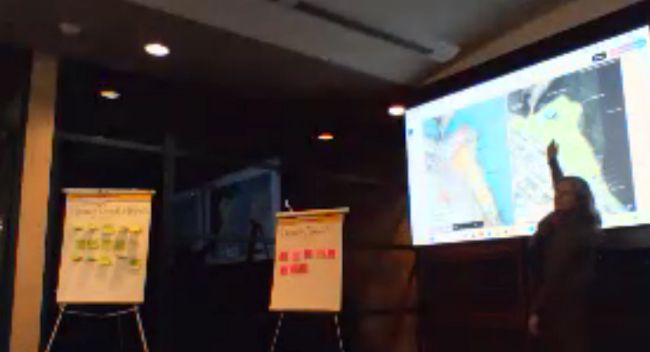
Roxanne Anderson points to the 9.2-acre area covered by the current EPA grant. Image from PCUL's online meeting.
Credit: Price County United Limited (PCUL), KSU TAB
Much more land than the 9.2 acres that the grant covers will need to be cleaned up as the property is 26.2 acres. Lynda "Lyn" Ludwig, PCUL's president, said the cleanup grant application was strategic; PCUL asked for funds to cover a small portion of the property as they cannot ask for funds again on the same area, so by not putting the entire area in the grant application, PCUL hopes to apply for more cleanup funds.
An audience member asked if these types of grants are still being awarded under the new administration in Washington, D.C., and Roxanne stated the last five years had a larger amount of grant money, and the future of additional grants is unknown.
PCUL is in the preparation stage of the cleanup. Asbestos inspections, sampling, and abatement have occurred. PCUL is evaluating which buildings will remain and which will be demolished. According to Roxanne, an architectural assessment needs to be done prior to demolishing any buildings, and PCUL must be in compliance with the National Historic Preservation Act. PCUL must submit a Remedial Action Plan (RAP) to the state. The Remedial Design Sampling has not started.
After cleanup, Roxanne said that site is then ready for reuse planning, which may include needing additional funding, community visioning, and public or private investment. She said the EPA does not give brownfield grant money after a site is cleaned up, because it is no longer a brownfield, so funds would need to be sought through something like the Federal Economic Development Department or for infrastructure or something wastewater specific.
Roxanne stated a common question people ask is, "Why does it feel like nothing is happening?" She said a lot of behind the scenes work needs to happen, stating that a project of this size could take "two to ten to fifteen years....It is a long haul." When asked by an audience member what would be needed to get it done in two years, she said a lot of money was the answer. She stated the timeline changes because adjustments need to be made.
If costs become greater than expected for cleanup, adjustments can be made, but the grant will not give any more funding for that acreage. When asked if $1.7 million was enough to clean up the area, Roxanne stated PCUL got what they could get and will probably need more money. The cleanup will remove environmental and legal barriers for the future investment of the property.
Ann Patros, an audience member, stated she is part of the Friends of PCUL, along with others. (The article continues after the following promotional message. Keep reading.)
Looking for a job in Price County? Assembly electrician, production painter, supply chain buyer, electrical designer, and more jobs are listed. Visit the Help Wanted Section at this link.
A meeting attendee asked if the type of soil contamination was known yet, and Roxanne said "yes and no." There are still a lot of steps in the process.
When asked if other grants have been awarded, Lyn stated no others have been awarded, but PCUL is applying for another grant at the end of this month.
An audience member asked if the city was involved as it didn't seem like the council members were "too into it." Roxanne said, "Ask them," but she added that it depends on the capacity and ownership, so the city can only do so much, plus staffing is limited without a full-time city planner. She called it an "evolving relationship." County Administrator Nick Trimner and City Aldermen Mark Brzeskiewicz were in attendance, and one county board member, Jordan Spacek, was in attendance online for a short time at the start of the two-hour long meeting. An in-person meeting attendee reported that Alderman Richard "Dick" Heitkemper was also there, but we were unable to confirm that information at the time of publication. Roxanne and Scott did speak to the council regarding PCUL at the city meeting the night prior.
Lyn said that PCUL had to pay $375,000 in back taxes, and she would like that money to be used as matching funds for future grants for which PCUL applies. Lyn shared, "It's very hard, because never has this happened in Price County. There's never been this massive redevelopment, and that's one of the reasons why we hired KSU to help get that message to them to help them show other examples of smaller communities and what happens with that back tax, what happens with that grant that needs to be matched, what happens when I ask for $180,000 to help partner different community members. It's not about, you know, it gets confusing, and it gets offensive, and it's misunderstood, you know, all this communication, so when the community gets really up in arms so then I need assistance, and so helping get that information of this complexity of a development like this when you have equipment and 41 buildings, and you have to get them to the ground level in a certain amount of time with cleanup, inspections, and it's very complex, so KSU can collaborate, so we are looking for a lot of collaboration, and don't worry, there's missteps, forgive and forget, and keep moving on. Okay, we are all in a community, and we love each other, but you have to love each other in a certain way to keep moving this project forward."
Since Roxanne had asked both the people in attendance and online to write down questions at the start of the meeting and submit them so they could be answered in the meeting, and some audience members were getting their questions answered, My Price County stated on chat that the chat members questions were not being answered, so Scott (of KSU) took the lead on asking some of those questions to Roxanne. My Price County submitted, in chat, seven of the questions that were most related to brownfields; (all the questions, including those seven, can be read in this article). Scott asked Lyn one of the questions, which was, "Once the 'community involvement' requirement is met for the brownfield grant, will PCUL still be giving updates and asking for public input on the revitalization aspect or will that end when the grant requirement ends?" Lyn said it was an excellent question and that PCUL would continue to keep the public informed on the website, blog, through Friends of PCUL, and walk and talk tours, and added that they need community input.
On chat, Jake B. asked "What are the materials that need to be removed? How were they identified?" He also asked, "How could the city benefit from light manufacturing in one of the buildings, as an example, if its on private property (i.e. owned by PCUL)? His question was not answered.
Tracy S. asked "What are the contaminants present and how is the remainder of cleanup being paid for once grant funds are used up?" Tracy later stated and asked, "I have not seen any information how the full project will get paid for. Also, what studies have been done and where is data to support that the Phillips and surrounding areas can support such a project and additional residency? Where will all the intended residents be employed to make enough income to purchase or rent or afford what the project is proposing and planning? Yes, growth can be good, but I have never seen how all this will be paid for or long-term financially sustained." Tracy's questions were not answered, either.
Scott was typing, possibly a response, when the online session ended for a second time. My Price County tried to enter the meeting again, which was wrapping up, but no one started the online portion again. Therefore, the remainder of the chat questions did not get answered. We reached out to Scott to see if he was typing a reply and what it was, and he replied that Roxanne will provide answers in the coming days. We also asked who determined there is contamination given former employees have stated they do not feel there is contamination at the site. My Price County will update this article when a response is received.
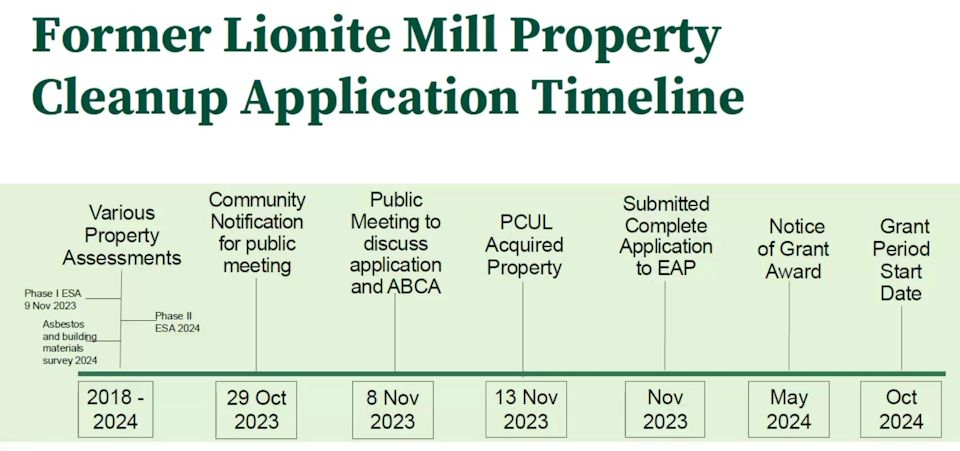
The former "Lionite" mill property cleanup application timeline was discussed at the meeting. Image from PCUL's online meeting.
Credit: Price County United Limited (PCUL), KSU TAB
A question that My Price County asked twice in chat is one we often get from community members, which is asking when PCUL purchased the Lionite property. The tax records show the transfer took place on April 1, 2024. However, at an April 1, 2024 city meeting, Lyn Ludwig asked the planning commission to correct the date of ownership of Lionite from November 11, 2023 to November 10, 2023, according to the meeting minutes. At the January 14, 2026 meeting, it was stated, and the timeline presented showed, that it was purchased on November 13, 2023. Numerous media sources have published an April 1, 2024 purchase date, which is also shown in the tax record for Price County. Community members feel this purchase date is important, because anyone receiving a brownfield grant is required to own the property when they apply for the grant. If PCUL applied in November of 2023 but did not own the property until April 1, 2024, grant funds could be revoked. If grant funds get revoked, community members are concerned what would happen to the property and project. Updated January 19, 2026: Regarding the date, the Price County Register of Deeds Office said, "The document is dated 'as of November 10, 2023' with the signature/notary acknowledgement of the prior owner dated March 21, 2024; both properties (Tax ID# 25783 & #25793) were recorded on the same Special Warranty Deed." The recording date is April 1, 2024.
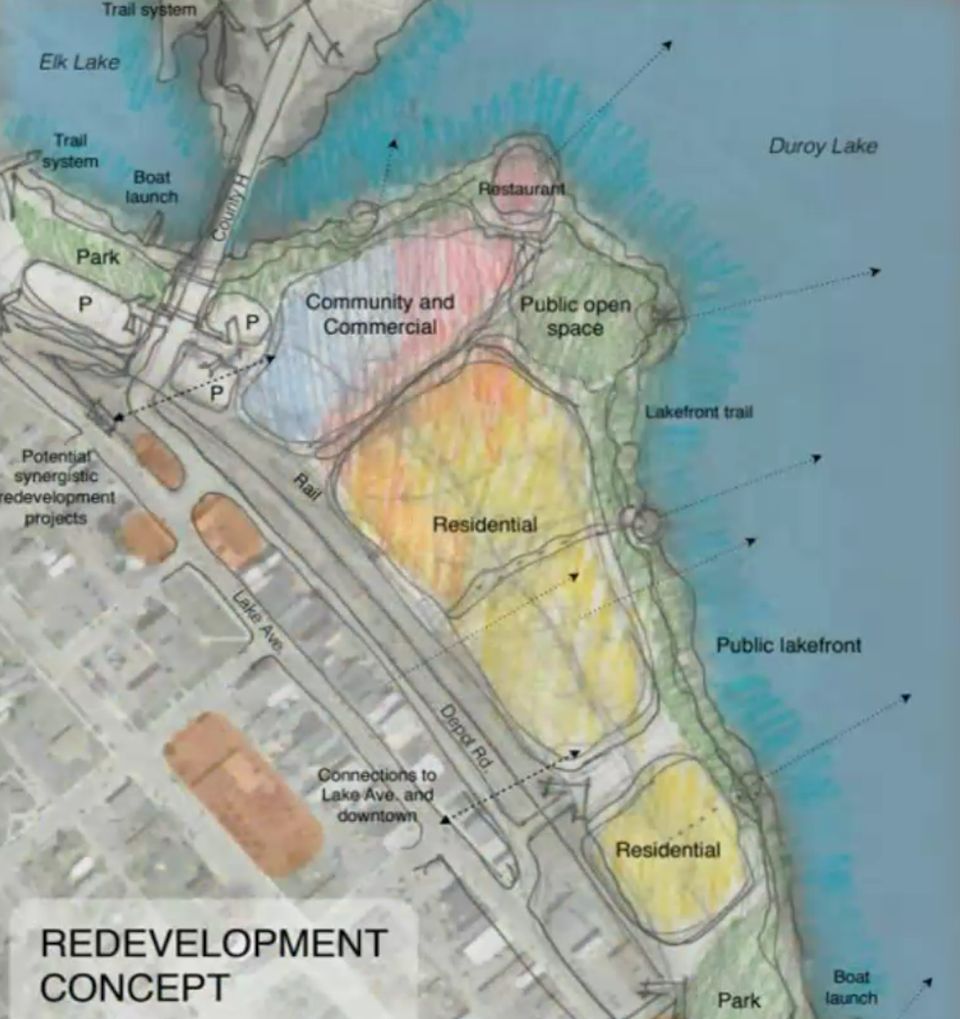
PCUL's proposed usage for the "Lionite" property. Image from PCUL's online meeting.
Credit: Price County United Limited (PCUL), KSU TAB
Another important question that community members want to know, though My Price County did not ask it at the meeting given it wasn't really a brownfields question, which was the topic of the meeting, is how tall the proposed residential buildings will be, because PCUL stated they wanted to demolish "Lionite" so community members could have a clear view of the lake, but if residences are then built there, the clear view of the lake will be gone once again. Also, as was asked but not answered at this meeting, where are all the people coming from that will live in the residential area and where will they work if there are already limited jobs in the area?
Finally, since "Lionite" is in a flood plain, a meeting attendee asked how that would be handled. It was stated that more soil could be brought in. The meeting attendee added that a lot of soil would be needed as the entire area was under water in the early 1990s and many people know the area to be wet, which is why it is a floodplain.
In the chat, My Price County asked PCUL to answer the questions we submitted on behalf of the community. If PCUL replies, we will publish those responses. My Price County wants good things to happen in Phillips, just like most residents also want, and we were hopeful about this project when it first came about in 2024. However, when PCUL does not answer community questions, it does not make the community feel comfortable with the project, which is what we continue to hear from people asking questions. We invite Lyn, Blake, and Cheryl, the three PCUL board members, to answer our questions, and we will write an article, publishing it to the 15,000 households that read our publication. Transparent, up-front answers will likely "clear the air" with many residents, which is what PCUL board members state they would like to happen.
![[Image: phillipspubliclibrary.jpg]](https://www.mynorthernwisconsin.com/display/phillipspubliclibrary.jpg)
Phillips Public Library, located at 286 Cherry Street in Phillips, has lots of activities and events planned for this month. Visit <u><a href="https://www.phillipspl.org" target="_blank">the library's website</a></u> for more information.
(This post was last modified: 02-01-2026, 05:16 AM by My Northern Wisconsin.)
During the evening, about four to seven people joined the virtual meeting, including My Price County. Not including the PCUL board members; KSU presenters; David Holmes, who is a geologist who works with PCUL; or the TV station, there were about 15 people physically in attendance, according to an attendee. The intent of the meeting was to "update the community on the status of the Lionite Cleanup Grant and to provide clarification needed regarding the process."
A brownfield was presented as a property that is difficult to develop because it is contaminated or believed to be contaminated with things like hazardous substances, petroleum, asbestos, lead paint, mold, meth-lab contaminants, and mine-scarred lands. For the "Lionite" property, there is asbestos and possibly some lead paint or other hazardous substances, according to PCUL.
An almost 1.7-million-dollar US EPA Brownfields Cleanup Grant was awarded to PCUL almost in May 2024. Those funds can be used for cleanup only (such as removing or treating contaminated soil, addressing petroleum or hazardous substances, asbestos or lead cleanup, or environmental monitoring and reporting) and not for redevelopment, buildings, or new construction.
PCUL gave a presentation in 2025 on the Analysis of Brownfield Cleanup Alternatives (ABCA) and will likely have two more presentations, one for the soil removal and one for further hazardous material abatement in buildings that will either remain or be demolished.
Roxanne Anderson points to the 9.2-acre area covered by the current EPA grant. Image from PCUL's online meeting.
Credit: Price County United Limited (PCUL), KSU TAB
Much more land than the 9.2 acres that the grant covers will need to be cleaned up as the property is 26.2 acres. Lynda "Lyn" Ludwig, PCUL's president, said the cleanup grant application was strategic; PCUL asked for funds to cover a small portion of the property as they cannot ask for funds again on the same area, so by not putting the entire area in the grant application, PCUL hopes to apply for more cleanup funds.
An audience member asked if these types of grants are still being awarded under the new administration in Washington, D.C., and Roxanne stated the last five years had a larger amount of grant money, and the future of additional grants is unknown.
PCUL is in the preparation stage of the cleanup. Asbestos inspections, sampling, and abatement have occurred. PCUL is evaluating which buildings will remain and which will be demolished. According to Roxanne, an architectural assessment needs to be done prior to demolishing any buildings, and PCUL must be in compliance with the National Historic Preservation Act. PCUL must submit a Remedial Action Plan (RAP) to the state. The Remedial Design Sampling has not started.
After cleanup, Roxanne said that site is then ready for reuse planning, which may include needing additional funding, community visioning, and public or private investment. She said the EPA does not give brownfield grant money after a site is cleaned up, because it is no longer a brownfield, so funds would need to be sought through something like the Federal Economic Development Department or for infrastructure or something wastewater specific.
Roxanne stated a common question people ask is, "Why does it feel like nothing is happening?" She said a lot of behind the scenes work needs to happen, stating that a project of this size could take "two to ten to fifteen years....It is a long haul." When asked by an audience member what would be needed to get it done in two years, she said a lot of money was the answer. She stated the timeline changes because adjustments need to be made.
If costs become greater than expected for cleanup, adjustments can be made, but the grant will not give any more funding for that acreage. When asked if $1.7 million was enough to clean up the area, Roxanne stated PCUL got what they could get and will probably need more money. The cleanup will remove environmental and legal barriers for the future investment of the property.
Ann Patros, an audience member, stated she is part of the Friends of PCUL, along with others. (The article continues after the following promotional message. Keep reading.)
Looking for a job in Price County? Assembly electrician, production painter, supply chain buyer, electrical designer, and more jobs are listed. Visit the Help Wanted Section at this link.
A meeting attendee asked if the type of soil contamination was known yet, and Roxanne said "yes and no." There are still a lot of steps in the process.
When asked if other grants have been awarded, Lyn stated no others have been awarded, but PCUL is applying for another grant at the end of this month.
An audience member asked if the city was involved as it didn't seem like the council members were "too into it." Roxanne said, "Ask them," but she added that it depends on the capacity and ownership, so the city can only do so much, plus staffing is limited without a full-time city planner. She called it an "evolving relationship." County Administrator Nick Trimner and City Aldermen Mark Brzeskiewicz were in attendance, and one county board member, Jordan Spacek, was in attendance online for a short time at the start of the two-hour long meeting. An in-person meeting attendee reported that Alderman Richard "Dick" Heitkemper was also there, but we were unable to confirm that information at the time of publication. Roxanne and Scott did speak to the council regarding PCUL at the city meeting the night prior.
Lyn said that PCUL had to pay $375,000 in back taxes, and she would like that money to be used as matching funds for future grants for which PCUL applies. Lyn shared, "It's very hard, because never has this happened in Price County. There's never been this massive redevelopment, and that's one of the reasons why we hired KSU to help get that message to them to help them show other examples of smaller communities and what happens with that back tax, what happens with that grant that needs to be matched, what happens when I ask for $180,000 to help partner different community members. It's not about, you know, it gets confusing, and it gets offensive, and it's misunderstood, you know, all this communication, so when the community gets really up in arms so then I need assistance, and so helping get that information of this complexity of a development like this when you have equipment and 41 buildings, and you have to get them to the ground level in a certain amount of time with cleanup, inspections, and it's very complex, so KSU can collaborate, so we are looking for a lot of collaboration, and don't worry, there's missteps, forgive and forget, and keep moving on. Okay, we are all in a community, and we love each other, but you have to love each other in a certain way to keep moving this project forward."
Since Roxanne had asked both the people in attendance and online to write down questions at the start of the meeting and submit them so they could be answered in the meeting, and some audience members were getting their questions answered, My Price County stated on chat that the chat members questions were not being answered, so Scott (of KSU) took the lead on asking some of those questions to Roxanne. My Price County submitted, in chat, seven of the questions that were most related to brownfields; (all the questions, including those seven, can be read in this article). Scott asked Lyn one of the questions, which was, "Once the 'community involvement' requirement is met for the brownfield grant, will PCUL still be giving updates and asking for public input on the revitalization aspect or will that end when the grant requirement ends?" Lyn said it was an excellent question and that PCUL would continue to keep the public informed on the website, blog, through Friends of PCUL, and walk and talk tours, and added that they need community input.
On chat, Jake B. asked "What are the materials that need to be removed? How were they identified?" He also asked, "How could the city benefit from light manufacturing in one of the buildings, as an example, if its on private property (i.e. owned by PCUL)? His question was not answered.
Tracy S. asked "What are the contaminants present and how is the remainder of cleanup being paid for once grant funds are used up?" Tracy later stated and asked, "I have not seen any information how the full project will get paid for. Also, what studies have been done and where is data to support that the Phillips and surrounding areas can support such a project and additional residency? Where will all the intended residents be employed to make enough income to purchase or rent or afford what the project is proposing and planning? Yes, growth can be good, but I have never seen how all this will be paid for or long-term financially sustained." Tracy's questions were not answered, either.
Scott was typing, possibly a response, when the online session ended for a second time. My Price County tried to enter the meeting again, which was wrapping up, but no one started the online portion again. Therefore, the remainder of the chat questions did not get answered. We reached out to Scott to see if he was typing a reply and what it was, and he replied that Roxanne will provide answers in the coming days. We also asked who determined there is contamination given former employees have stated they do not feel there is contamination at the site. My Price County will update this article when a response is received.
The former "Lionite" mill property cleanup application timeline was discussed at the meeting. Image from PCUL's online meeting.
Credit: Price County United Limited (PCUL), KSU TAB
A question that My Price County asked twice in chat is one we often get from community members, which is asking when PCUL purchased the Lionite property. The tax records show the transfer took place on April 1, 2024. However, at an April 1, 2024 city meeting, Lyn Ludwig asked the planning commission to correct the date of ownership of Lionite from November 11, 2023 to November 10, 2023, according to the meeting minutes. At the January 14, 2026 meeting, it was stated, and the timeline presented showed, that it was purchased on November 13, 2023. Numerous media sources have published an April 1, 2024 purchase date, which is also shown in the tax record for Price County. Community members feel this purchase date is important, because anyone receiving a brownfield grant is required to own the property when they apply for the grant. If PCUL applied in November of 2023 but did not own the property until April 1, 2024, grant funds could be revoked. If grant funds get revoked, community members are concerned what would happen to the property and project. Updated January 19, 2026: Regarding the date, the Price County Register of Deeds Office said, "The document is dated 'as of November 10, 2023' with the signature/notary acknowledgement of the prior owner dated March 21, 2024; both properties (Tax ID# 25783 & #25793) were recorded on the same Special Warranty Deed." The recording date is April 1, 2024.
PCUL's proposed usage for the "Lionite" property. Image from PCUL's online meeting.
Credit: Price County United Limited (PCUL), KSU TAB
Another important question that community members want to know, though My Price County did not ask it at the meeting given it wasn't really a brownfields question, which was the topic of the meeting, is how tall the proposed residential buildings will be, because PCUL stated they wanted to demolish "Lionite" so community members could have a clear view of the lake, but if residences are then built there, the clear view of the lake will be gone once again. Also, as was asked but not answered at this meeting, where are all the people coming from that will live in the residential area and where will they work if there are already limited jobs in the area?
Finally, since "Lionite" is in a flood plain, a meeting attendee asked how that would be handled. It was stated that more soil could be brought in. The meeting attendee added that a lot of soil would be needed as the entire area was under water in the early 1990s and many people know the area to be wet, which is why it is a floodplain.
In the chat, My Price County asked PCUL to answer the questions we submitted on behalf of the community. If PCUL replies, we will publish those responses. My Price County wants good things to happen in Phillips, just like most residents also want, and we were hopeful about this project when it first came about in 2024. However, when PCUL does not answer community questions, it does not make the community feel comfortable with the project, which is what we continue to hear from people asking questions. We invite Lyn, Blake, and Cheryl, the three PCUL board members, to answer our questions, and we will write an article, publishing it to the 15,000 households that read our publication. Transparent, up-front answers will likely "clear the air" with many residents, which is what PCUL board members state they would like to happen.
Phillips Public Library, located at 286 Cherry Street in Phillips, has lots of activities and events planned for this month. Visit <u><a href="https://www.phillipspl.org" target="_blank">the library's website</a></u> for more information.